
The Control Illusion: Why Your Brain's Favorite Safety Strategy Is Slowly Destroying Your Life
"We must be willing to let go of the life we planned so as to have the life that is waiting for us." —Joseph Campbell
A Therapist's Reflection: When You Build Your House on Cracked Posts
After sitting with clients, I've noticed a pattern that breaks my heart every single week: most people aren't actually anxious about what's happening right now. They're terrified of what might happen if they're not controlling what's happening right now.
I've watched clients dissect every tone in their partner's voice like forensic analysts looking for evidence of abandonment. I've seen people over-prepare for work scenarios so obsessively they can't sleep. I've sat with individuals who monitor their bodies for symptoms with such hypervigilance they create the very anxiety they're trying to prevent. They rehearse difficult conversations 40 times in their head before bed, then lie awake replaying all 40 versions, searching for the perfect one that will guarantee safety.
They're exhausted. Hypervigilant. Emotionally flooded. Running on fumes and catastrophic thinking.
And when I gently ask, "What are you actually trying to prevent?" the answer is almost always some version of: "I can't afford for this to go wrong. If I'm not on top of everything, it will all fall apart. I'll be alone. I'll fail. I'll be hurt again."
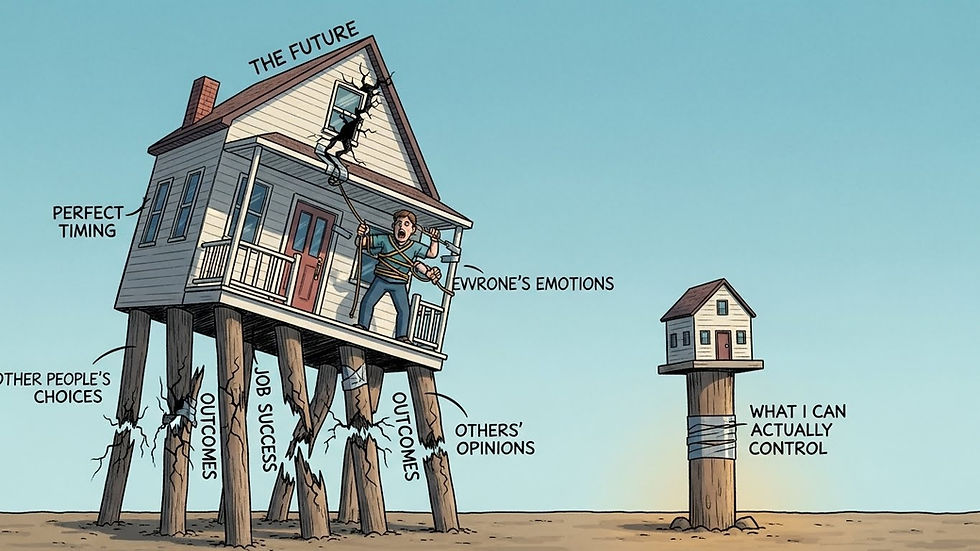
Here's where I often introduce a metaphor that lands hard: Imagine you're building a house—your life, your sense of safety, your identity—but you're building it on posts. Tall, thin posts that you're desperately trying to keep stable. Each post represents something you're trying to control: other people's choices, perfect timing, everyone's emotions, outcomes, the future.
And here's the problem: those posts have cracks in them. Deep cracks. Because they were never designed to hold the weight of your entire house.
The more weight you put on them—the more you invest your peace, your worth, your safety in controlling these things—the more the cracks spread. And now your house is sliding. Tilting. You're frantically running around with duct tape and rope, trying to patch the posts, shore them up, keep everything from collapsing.
Meanwhile, there's solid ground right next to you. Stable foundation. But you can't see it because you're so busy trying to keep those cracked posts from breaking.
Here's the quiet, devastating truth I've learned: compulsive control is rarely about power. It's about fear. It's a nervous system strategy. It's your brain's last-ditch attempt to not get hurt again.
And—this is the hardest part to accept—it doesn't work. Those posts were never meant to hold your house. They crack under the weight they were never designed to bear.
I've seen clients try to control things that were literally never theirs to control: other people's choices, outcomes, timing, emotional weather, the future, randomness, life itself. They micromanage reality like it's a malfunctioning machine, believing that if they just find the right lever, patch the right crack, they can fix everything and finally feel safe. And these things don't belong to you. They are OUTSIDE of your control.
And when reality does what reality does—refuses to obey, unfolds unpredictably, brings pain anyway—they don't just feel disappointed. They feel shattered. They interpret it as personal failure, proof that they didn't do enough, didn't try hard enough, didn't control well enough. Another crack appears, and they grab more duct tape.
In session, I sometimes offer a version of the Serenity Prayer: "Grant me the serenity to accept the things I cannot control, the courage to change the things I can, and the wisdom to know the difference."
That last part—the difference—is where most psychological suffering lives. It's the difference between cracked posts and solid ground. Between what can actually hold weight and what will always crack under pressure.
It's also where liberation waits—where you finally stop patching posts and start building on foundation that was designed to hold you.
Let's talk about that difference, and why learning it might save your life.
The Psychology of the Grip: Why We Clench So Hard
Control is, at its core, a safety behavior. When something in your environment feels uncertain or threatening, your brain doesn't politely pause to ask, "How do I feel about this?" It immediately scans for one thing: "Where can I get leverage? What can I manage? How do I prevent disaster?"
Psychologically, the drive to control comes from two sources:
Perceived instability in the world ("Everything around me is unpredictable and dangerous")
Perceived instability in the self ("I can't trust myself to handle what comes")
When your external world has felt chaotic—unpredictable caregivers, trauma, sudden loss, betrayal—your nervous system learns a simple, powerful equation: "If I'm not on guard, I get hurt." Research on developmental trauma shows that chronic unpredictability in early environments literally wires the brain toward hypervigilance and threat monitoring as a survival strategy [1].
Control becomes a reflex, not a choice. It's not a character flaw or personality defect—it's evidence of survival intelligence in a hostile environment.
On the flip side, when your internal world feels chaotic—overwhelming emotions, shame spirals, not trusting your own judgment or capacity to cope—the instinct is to regulate the outside instead of the inside. The logic is seductive: "If I can't soothe my fear internally, I'll prevent the external thing that scares me from ever happening. If I can't trust myself to handle pain, I'll construct an entire life around avoiding it."
This is not pathology. This is brilliant adaptation.
But here's the trap that will consume your life: the more you demand total control, the more you experience ordinary unpredictability as personal catastrophe.
You begin to interpret normal life events as existential threats:
"They didn't text back in an hour" becomes "I'm being abandoned and I'm unlovable"
"The project got delayed" becomes "I'm incompetent and everyone knows I'm a fraud"
"My partner seems distant tonight" becomes "The relationship is ending and it's all my fault"
In clinical terms, this is the illusion of control—the cognitive bias where we massively overestimate how much influence we actually have over outcomes [2]. And here's the cruel irony that keeps people trapped: people higher in anxiety show stronger illusion-of-control responses, especially in uncertain conditions [2].
Translation? The need to control creates the anxiety that justifies more control. You're caught in a self-reinforcing loop where your solution is actually your problem. That loop will eat your life, relationships, peace, and health.
Internal vs. External Locus of Control: Finding the Wisdom in the Middle
Psychologist Julian Rotter introduced the concept of "locus of control"—essentially, where you believe power in life actually lives [3]:
Internal locus of control: "What I do matters. My choices influence outcomes. I have agency."
External locus of control: "Things just happen to me. I'm powerless. Nothing I do makes a difference."
Here's what most people miss: neither extreme is healthy or accurate.
Skew too external and you drift into learned helplessness—that numb, hopeless depression where nothing you do matters, so why bother trying? This predicts higher rates of depression and poor stress tolerance [4]. You become a passive victim of circumstances, waiting for life to happen to you.
Skew too internal and you hold yourself responsible for literally everything, including things no human being could possibly control—other people's choices, timing, outcomes, even random events. This predicts chronic anxiety, guilt, burnout, and toxic shame. You become God's understudy, exhausted from a job you were never meant to do.
The goal is not "control everything" or "control nothing." The goal is accurate control mapping.
Accurate control mapping sounds like this:
"I can't control whether this person likes me, but I can control whether I show up authentically"
"I can't control how fast this heals, but I can control how I care for my body during the healing process"
"I can't control the market, but I can control my preparation, my response, and my willingness to ask for help"
"I can't control their choice, but I can control my boundaries around their behavior"
Research shows that people with grounded internal locus of control—meaning they accurately recognize and act on what's genuinely within their influence—demonstrate better problem-solving, lower stress, and significantly higher psychological resilience [3][5].
That's not because they dominate life or prevent all problems. It's because they stop wasting precious energy fighting reality and instead invest it strategically in what's actually movable.
The Hidden Price: What Chronic Control Is Costing You
Let's talk about the real cost of your desperate grip, because the price is much higher than you realize:
1. You Live in Perpetual Survival Mode
Trying to "hold it all together" keeps your sympathetic nervous system chronically activated—you're essentially living in low-grade fight-or-flight 24/7. Elevated cortisol over time is directly linked to anxiety, irritability, sleep disruption, immune suppression, and cognitive rigidity [6]. You become less flexible mentally and emotionally. Your body is literally aging faster because your brain thinks you're under constant attack.
2. You Confuse Hypervigilance with Love
You start believing "If I stop worrying, I don't care. If I'm not monitoring them, I don't love them." This is particularly toxic in relationships. But constant surveillance of someone else's behavior, mood, or choices isn't love—it's anxiety management using another person as your regulation object. Real love trusts. Anxious control suffocates everyone involved.
3. You Collapse When Reality Refuses to Obey
If your internal operating system runs on "It's my job to prevent all bad outcomes," then any pain, loss, or difficulty becomes proof that you personally failed. That is a brutal, inaccurate, and completely unsustainable way to live. You're not God. You're not responsible for controlling the universe. You never were.
4. You Never Actually Feel Safe
Because your sense of safety isn't rooted in trust, self-regulation, or acceptance of life's inherent uncertainty. It's contingent on successful control, which is always temporary and conditional. You're only okay if everything is currently okay. The moment anything shifts—someone's mood changes, plans get disrupted, outcomes deviate from your script—you're back in panic mode.
That's not safety. That's conditional, fragile peace that requires constant maintenance. That's a full-time job with no vacation, no breaks, and no retirement plan.
Research confirms this devastating irony: people who score high on "control through worry" actually report lower perceived safety, higher baseline stress, and less effective coping [7]. White-knuckling your life doesn't prevent pain or create security. It just guarantees you'll be tense, exhausted, and hypervigilant when pain inevitably arrives anyway.
The Liberation Paradox: How Surrender Creates Real Power
Here's the part people fight me on hardest in therapy, so I'm going to say it clearly: letting go of control is not passive. It's not giving up. It's not weakness. It's not defeat.
Acceptance in psychological literature—especially in Acceptance and Commitment Therapy (ACT)—is not "Oh well, whatever happens, happens." It's not resignation or helplessness.
Acceptance is: "I am willing to acknowledge what is actually real so I can take effective action where I genuinely have power" [8].
That is an act of precision, not passivity. That is strategic clarity, not surrender to chaos. That is profound strength, not weakness.
When you stop hemorrhaging precious energy on what is genuinely not influenceable, you get that energy back. You can redirect it toward what actually matters and what you can actually affect: boundaries, honest communication, self-care, relational repair, emotional regulation, grief processing, meaningful change.
The surrender of fantasy control is the birth of real agency.
This is why the Serenity Prayer shows up in every recovery space on earth. It's not spiritual decoration or therapeutic platitude. It's a survival algorithm that actually works when you work it.
The Recalibration Protocol: Practical Steps to Break Free
Here are evidence-based practices to begin untangling from destructive control patterns and building healthier, more accurate agency:
Practice 1: The 3-Column Reality Check
Draw three columns: "What I Can Control," "What I Can Influence," "What I Cannot Control."
Write your current stressor at the top. Sort every element of the situation into these three categories with ruthless honesty. Then—and this is crucial—act only inside the first two columns. Let the third column go entirely.
Why this works: Cognitive-behavioral research demonstrates that structured appraisal reduces catastrophic thinking and increases problem-focused coping [9]. You're literally training your brain to stop globalizing fear and start targeting effort where it can actually create change.
Practice 2: Nervous System Before Narrative
Before you try to "solve" anything, regulate first. Slow breathing. Grounding exercises. Self-soothing touch. Progressive muscle relaxation. You are absolutely not allowed to "fix" problems while in full panic mode.
Why this works: You literally cannot make strategic, clear-headed choices while your sympathetic nervous system is fully activated. Executive function and emotional regulation only come online when your parasympathetic system is engaged [6]. Calm your body first. Then engage your thinking brain. In that order.
Practice 3: The Language Audit
Notice any sentence in your internal dialogue that starts with "I have to make sure..." or "I need to prevent..." and consciously rewrite it to "I will show up as..."
Examples:
"I have to make sure they don't get upset with me" → "I will communicate clearly and kindly, and let them have their own reactions"
"I need to prevent this from going wrong" → "I will do my part with care and accept that I can't control outcomes"
"I have to make sure they choose me" → "I will be authentically myself and trust the right people will stay"
Why this works: Shifting from outcome-control language to values-based behavior language significantly increases psychological flexibility and reduces guilt/shame responses [8]. You're relocating your power from things you can't control (outcomes) to things you can (your integrity and actions).
Practice 4: The Grief Honesty Practice
Name what you actually, genuinely cannot control and allow yourself to grieve it. Say it out loud or write it down:
"I cannot make them choose me or love me"
"I cannot stop time or prevent aging and death"
"I cannot keep everyone I love completely safe from all harm"
"I cannot control outcomes, only my integrity in the process"
"I cannot prevent all pain for myself or others"
Why this works: Suppressed grief almost always transforms into frantic, compulsive control strategies [1]. When you allow yourself to genuinely grieve what you cannot change, you restore emotional realism. This supports healthier boundaries, reduces compulsive rescue behavior, and creates space for acceptance.
Practice 5: The Daily Responsibility Check
Multiple times throughout your day, pause and ask yourself: "Is this actually my job? Am I responsible for this outcome/person/situation?"
Why this works: Boundary clarity directly correlates with reduced caregiver burnout and healthier relationship functioning [10]. Most people who chronically over-control are unconsciously doing 15 invisible jobs that no one ever hired them to do—jobs they assigned themselves out of fear, guilt, or trauma patterns.
Letting go is not abandonment of responsibility. It's an accurate reorganization of responsibility.
Your Invitation to Freedom
You are not failing because you can't hold the entire universe together. You were never supposed to.
Trying to control what was never yours to manage is a trauma response, not a character strength. Learning to release that impossible burden is healing, not weakness. This is the difference between surviving and actually living.
Your work—your only work—is not to dominate all outcomes or prevent all difficulties. Your work is to:
Show up with integrity
Act where you have genuine power
Tolerate uncertainty where you don't have control
Allow life to unfold without interpreting every challenge as proof you should have done more, tried harder, or controlled better
That's not giving up. That's growing up.
Control isn't love, and surrender isn't weakness. Sometimes the strongest thing you can do is unclench your fists and open your hands.
The tightest grip cannot hold water. But cupped hands can receive it.
What are you finally ready to release?
REFERENCES
[1] van der Kolk, B. A. (2014). The Body Keeps the Score: Brain, Mind, and Body in the Healing of Trauma. Viking.
[2] Langer, E. J. (1975). The illusion of control. Journal of Personality and Social Psychology, 32(2), 311–328.
[3] Rotter, J. B. (1966). Generalized expectancies for internal versus external control of reinforcement. Psychological Monographs, 80(1), 1–28.
[4] Peterson, C., & Seligman, M. E. P. (1984). Causal explanations as a risk factor for depression. Psychological Review, 91(3), 347–374.
[5] Lefcourt, H. M. (1982). Locus of Control: Current Trends in Theory and Research. Lawrence Erlbaum Associates.
[6] McEwen, B. S. (1998). Protective and damaging effects of stress mediators. New England Journal of Medicine, 338(3), 171–179.
[7] Borkovec, T. D., et al. (1998). Worry: A cognitive phenomenon intimately linked to affective, physiological, and interpersonal behavioral processes. Cognitive Therapy and Research, 22(6), 561–576.
[8] Hayes, S. C., et al. (1999). Acceptance and Commitment Therapy: An Experiential Approach to Behavior Change. Guilford Press.
[9] Beck, A. T. (1976). Cognitive Therapy and the Emotional Disorders. International Universities Press.
[10] Maslach, C., et al. (2001). Job burnout. Annual Review of Psychology, 52(1), 397–422.


Comments